Taking your parents to Kashmir can be one of those trips that stays with the family for years.
But if you are travelling with senior citizens, planning Kashmir is slightly different from planning a trip with friends or younger family members. The question is not simply "What should we see?" It is "How much walking is involved? How high are we going? How many stairs are there? Can my parents rest easily? What happens if they feel unwell?"
That distinction matters.
Kashmir itself is not uniformly high altitude. Srinagar, for example, sits at about 1,585 metres (5,200 feet) above sea level. Gulmarg, by comparison, is around 2,650–2,730 metres depending on the reference, while the second phase of the Gulmarg Gondola reaches about 12,293 feet (3,747 metres).
For a healthy older traveller, this does not automatically make Kashmir unsuitable. It simply means the itinerary needs to respect the difference between a relaxed Srinagar holiday and a day spent suddenly travelling to nearly 12,300 feet.
Here is what Indian families should know before taking senior citizens to Kashmir.
First: Separate Kashmir from High-Altitude Kashmir
One of the biggest mistakes families make is treating the entire Kashmir Valley as if it has the same altitude.
It doesn't.
Srinagar is usually the easier base
Srinagar is considerably lower than Gulmarg and many of the higher mountain excursions. At approximately 1,585 metres, it is a much more forgiving base for a relaxed holiday.
That makes Srinagar particularly useful when travelling with parents who:
- tire easily after prolonged walking
- have limited mobility
- are uncomfortable with steep climbs
- need frequent rest periods
- are not accustomed to mountain environments
- have medical conditions that require more cautious travel planning
A senior-friendly Kashmir itinerary can therefore use Srinagar as the comfortable base and treat higher destinations as optional experiences rather than obligations.
This is an important mindset change: your parents do not need to "complete" every attraction for the trip to be successful.
Altitude: The Part Families Should Take Seriously
At altitude, the issue is not that the percentage of oxygen in the air suddenly disappears. The air still contains roughly the same proportion of oxygen, but atmospheric pressure falls, meaning each breath delivers fewer oxygen molecules to the body.
Altitude illness can occur even in otherwise healthy travellers. The CDC considers travel to elevations around 8,000 feet and above relevant for altitude-illness precautions, with risk influenced by how quickly someone ascends and individual susceptibility.
That becomes particularly relevant in Gulmarg.
Why Gulmarg needs more thought
Gulmarg itself is already considerably higher than Srinagar. More importantly, the Gondola can take visitors much higher in a relatively short period.
The official Kashmir administration lists the first Gondola phase at approximately 8,530 feet and the second phase at approximately 12,293 feet.
That second jump is significant for a senior traveller who has only recently arrived in Kashmir.
Possible symptoms of altitude illness include:
- headache
- unusual tiredness
- nausea
- loss of appetite
- vomiting
More serious altitude-related conditions can cause extreme fatigue, confusion, poor coordination or significant breathing difficulty and require urgent descent and medical attention.
Don't use a pulse oximeter as your only decision-maker
Many Indian families now carry a small pulse oximeter while travelling with elderly parents. It can be useful for monitoring, particularly when a doctor has advised you to track oxygen saturation.
But don't turn one reading into a simple rule such as "95 is safe, 90 is dangerous."
Readings vary with the person, device, circulation, temperature and circumstances. More importantly, symptoms matter.
If a parent develops significant breathlessness, confusion, severe weakness or worsening symptoms at altitude, the appropriate response is not simply to sit in the hotel and keep checking the oximeter.
Medical advice and, where appropriate, descent are more important.
Speak to the doctor before the trip
This is particularly important if your parent has:
- heart disease
- lung disease
- significant hypertension
- diabetes
- reduced exercise tolerance
- a history of altitude-related problems
- regular prescription medication
The CDC specifically recommends that older travellers discuss their health conditions, medications, itinerary and planned high-altitude activities with a healthcare professional before travelling.
If your itinerary includes Gulmarg's higher elevations, mention the actual altitude and activity to the doctor rather than simply saying "we are going to Kashmir."
Walking Is Often a Bigger Problem Than Distance
When families say, "My mother can walk," that does not necessarily answer the accessibility question.
A person may comfortably walk 500 metres on a flat road but struggle with:
- uneven stone pathways
- snow or ice
- slopes
- repeated stairs
- standing for long periods
- getting in and out of vehicles
- wet or slippery surfaces
- walking immediately after a long drive
This is why sightseeing should be planned around effort, not kilometres.
Think in terms of "walking load"
Before adding an attraction to the itinerary, ask:
How does my parent actually experience this place?
For every stop, consider:
- How close can the vehicle get?
- Is the surface paved or uneven?
- Are there stairs?
- Is seating available?
- Is there a washroom nearby?
- How long might they have to stand?
- Is there somewhere warm to wait?
- Can we leave easily if they become tired?
That simple checklist is far more useful than a generic "senior citizen-friendly" label.
Houseboats: Beautiful, but Don't Assume They Are Accessible
A Dal Lake houseboat is one of Kashmir's signature experiences, and many families naturally want their parents to experience it.
But a houseboat should not automatically be treated as equivalent to a ground-floor hotel.
The accommodation itself is a boat, and access begins at the lake rather than at a conventional hotel lobby. Depending on the property and arrangement, guests may need to move between the shore/ghat and the houseboat before reaching their room.
There is another detail families sometimes discover only after arrival: room location.
Some houseboats place accommodation on an upper deck, meaning stairs may be involved. Individual properties differ, so this cannot safely be assumed either way.
Ask these questions before booking a houseboat
Don't just ask, "Is it a deluxe houseboat?"
Ask:
- How many steps are there from the ghat to the houseboat?
- Is there a handrail?
- Are the bedrooms on the same level as the entrance?
- Is the bathroom attached to the room?
- Are there steps inside the houseboat?
- Can a senior citizen reach the room without climbing stairs?
- How far is the vehicle drop-off point from the boarding point?
- Can staff assist with luggage and boarding?
- Is the approach slippery during rain or winter?
If your parent uses a walking stick or has serious mobility limitations, ask the property to describe the physical access rather than relying on photographs.
For some families, one night on a carefully selected houseboat followed by a conventional hotel is a better compromise than spending the entire stay on the lake.
Choosing a Senior-Friendly Hotel in Kashmir
A "luxury hotel" is not automatically a senior-friendly hotel.
For elderly travellers, practical design often matters more than the star rating.
What to look for
Prioritise a property with:
- lift access to guest floors
- rooms close to the lift
- minimal internal stairs
- walk-in or low-threshold shower where available
- western-style toilet with comfortable access
- grab bars or other bathroom support where available
- reliable heating in colder months
- comfortable seating inside the room
- easy vehicle drop-off
- an on-site restaurant or convenient meal arrangements
- staff who can assist elderly guests
- pharmacy/medical facilities reasonably accessible from the property
And one of the most important questions:
"Can the car reach the hotel entrance?"
A beautiful hotel located at the end of a pedestrian approach may be a poor choice for an elderly traveller compared with a less glamorous property where the vehicle can stop directly outside.
Srinagar versus staying at higher destinations
For many families travelling with elderly parents, it makes sense to spend more nights in Srinagar and fewer nights at higher-altitude destinations.
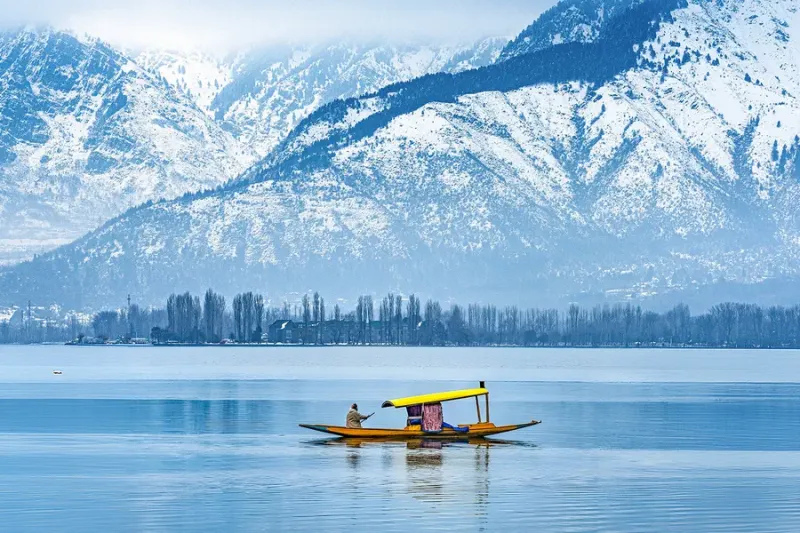
Srinagar also offers a wide range of relatively low-effort experiences: gardens, Dal Lake, Shikara rides and sightseeing that can be adapted around the family's energy level. The city's official tourism information also highlights its houseboats, gardens and lake experiences.
This does not mean avoiding Gulmarg or Pahalgam altogether.
It means making them flexible parts of the itinerary.
What About the Gulmarg Gondola?
This is probably the question families ask most often:
"Can senior citizens take the Gulmarg Gondola?"
Age alone does not provide the answer.
The more important questions are:
- How does the person normally tolerate altitude?
- Do they have heart or lung conditions?
- Have they recently arrived from the plains?
- Are they comfortable standing and walking around the station?
- What is the weather like that day?
- Is Phase 1 sufficient for the family?
- Does the doctor consider the higher elevation appropriate?
The Gondola's two phases are not merely two sightseeing viewpoints at roughly the same elevation. The second phase reaches around 12,293 feet.
For a senior traveller, Phase 2 should be treated as a high-altitude excursion, not simply as "the second half of the ride."
If there is any doubt, there is no prize for completing Phase 2.
A comfortable family sitting in Gulmarg or enjoying Phase 1 may have a far better day than a parent being pushed into a higher altitude because everyone else has bought the ticket.
Build the Itinerary Around Recovery Time
One of the most useful changes you can make when travelling with parents is to stop treating every day as a sightseeing day.
A senior-friendly Kashmir itinerary should have breathing space.
A better rhythm
Instead of:
Arrival → sightseeing → long drive → hotel → sightseeing → another long drive
consider:
Arrival → rest → light sightseeing
then:
Srinagar → one major outing → relaxed evening
and only then:
higher-altitude excursion, if suitable
This also gives you a chance to notice how your parent is responding to Kashmir before committing to more demanding excursions.
The CDC recommends gradual ascent where possible and advises against going higher when altitude-illness symptoms are present.
Winter Changes the Accessibility Equation
Kashmir in winter can be spectacular, but snow and ice change the practical difficulty of almost everything.
A route that is easy on a dry summer morning can become considerably harder when surfaces are wet, icy or snow-covered.
For senior citizens, this increases the importance of:
- proper winter footwear
- warm layers
- avoiding unnecessary outdoor waiting
- choosing accommodation with good heating
- reducing unnecessary walking
- checking weather and road conditions before mountain excursions
- allowing extra time rather than rushing
The Srinagar district administration currently describes winter as cold and snowy and recommends heavy woollens, insulated clothing and appropriate footwear.
For an older traveller with balance problems, slipping may be a greater immediate concern than the cold itself.
A Practical Senior-Citizen Kashmir Checklist
Before leaving India for Kashmir, or before finalising the itinerary, check the following.
Medical preparation
- Speak to the treating doctor about the complete itinerary.
- Carry regular medicines in sufficient quantity.
- Keep prescriptions and relevant medical records accessible.
- Carry a basic first-aid kit.
- If the doctor recommends monitoring equipment, carry it.
- Know which symptoms should trigger medical attention.
Hotel preparation
- Confirm lift availability.
- Request a room near the lift if appropriate.
- Confirm the bathroom layout.
- Ask about heating.
- Confirm vehicle access to the entrance.
- Avoid assuming "ground floor" means easy access.
Houseboat preparation
- Ask about the boarding route.
- Confirm the number of steps.
- Request a room without internal staircase access if possible.
- Confirm bathroom location.
- Ask whether staff can assist with boarding.
Sightseeing preparation
- Keep one major activity per day where possible.
- Schedule rest after long drives.
- Avoid stacking multiple high-effort attractions together.
- Keep higher-altitude activities optional.
- Carry water, snacks and medicines.
- Use comfortable, non-slip footwear.
Transport preparation
When travelling with elderly parents, the vehicle becomes part of the accessibility plan.
A comfortable car, sensible driving pace and fewer unnecessary vehicle changes can make a surprisingly large difference.
Tell the travel planner or driver in advance if someone in the group has difficulty climbing into a high vehicle, needs frequent breaks or cannot comfortably walk long distances.
This is exactly the sort of information a travel company such as Bookmywings should know before building the itinerary, rather than discovering after the family reaches Kashmir.
The Best Kashmir Trip With Parents Is Not the Most Ambitious One
Kashmir does not need to be experienced at full speed.
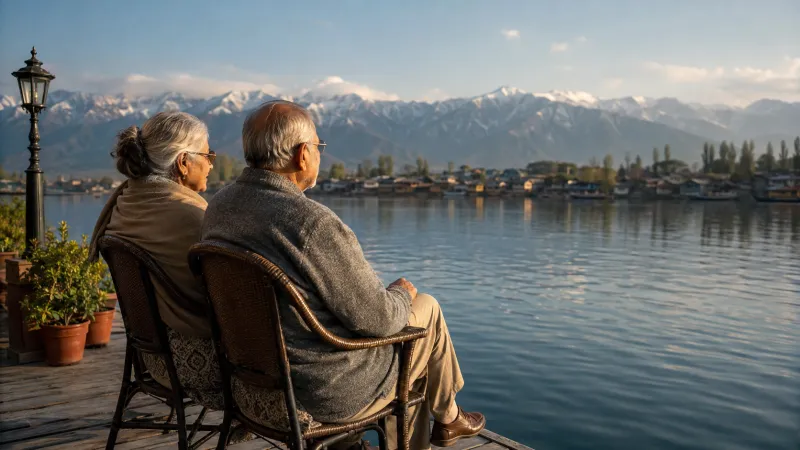
For senior citizens, some of the best moments may come from sitting beside Dal Lake with a cup of kahwa, taking a relaxed Shikara ride, looking at the mountains from a comfortable hotel or simply spending an unhurried afternoon together.
The practical lesson is straightforward:
Choose comfort before coverage.
Srinagar can be your easier base. Gulmarg can be an optional higher-altitude experience. A houseboat can be memorable if its physical access suits your parents. And the Gondola can be considered based on health, acclimatisation, weather and medical advice—not simply because it appears on every Kashmir itinerary.
When taking senior citizens to Kashmir, good planning is not about removing adventure from the holiday.
It is about making sure that the people you brought to enjoy Kashmir still have the energy to enjoy it.