Vaishno Devi Battery Car, Ropeway & Helicopter: How to Book and Who Should Use What
For many Indian families, planning a Vaishno Devi Yatra is not really about whether they can reach the shrine.
It is about how much of the climb they should attempt on foot.
The traditional journey from Katra to Bhawan is physically demanding, particularly for senior citizens, young children, travellers with limited mobility and anyone who is not comfortable with a long uphill walk. The Shri Mata Vaishno Devi Shrine Board therefore operates several transport and access facilities—but they are not interchangeable.
This is where many first-time pilgrims get confused.
A battery car does not take you from Katra to Bhawan.
The ropeway does not take you from Katra to the shrine.
And a helicopter does not land at the main shrine entrance on the regular Katra–Sanjichhat service.
Each solves a different part of the pilgrimage.
The Shrine Board currently lists helicopter and battery-car facilities as options for travelling towards Bhawan, while its passenger ropeway connects Bhawan with Bhairon Ji Temple.
Understanding that distinction before booking can make the yatra considerably smoother.
The Three Options at a Glance
FacilityWhat it actually doesBest suited forBattery CarCovers the Adhkuwari–Bhawan section on the Himkoti/alternate routeSeniors, families wanting to reduce walking, pilgrims who can still manage part of the yatraBhawan–Bhairon RopewayConnects Bhawan with Bhairon Ji TempleSeniors, children, tired pilgrims and anyone wanting to avoid the steep Bhairon climbKatra–Sanjichhat HelicopterCovers the major Katra-to-Sanjichhat section by airSeniors, mobility-limited pilgrims, families short on time, those wanting to minimise the long trekJammu–Panchi/Bhawan helicopter sectorSeparate helicopter product with different booking arrangementsPilgrims seeking an air-based Jammu–Bhawan option, subject to current availability/package rules
The important point is that these services can also be combined.
For example, a family may fly from Katra to Sanjichhat, walk the remaining stretch to Bhawan, use the ropeway for Bhairon Ji and then return according to whichever transport option is booked and available.
First, Complete Your Yatra Registration
Before worrying about battery cars or helicopters, make sure the basic pilgrimage registration is in place.
The Shrine Board states that pilgrims must register for the Yatra and obtain an RFID-based Yatra Access Card. Online-registered pilgrims are instructed to collect the RFID card from designated Yatra Registration Counters by showing their online booking slip.
This is an important distinction:
Transport booking does not replace Yatra registration.
Keep your booking confirmations and identity documents accessible rather than buried inside your luggage.
Vaishno Devi Battery Car: The Most Misunderstood Option
The battery car is probably the most useful facility for families who want to reduce the physical effort of the yatra without completely eliminating the walking experience.
But it has a specific route.
Where does the battery car operate?
The Shrine Board's battery-car service operates between Adhkuwari and Bhawan on the Himkoti Marg/alternate track. The Board has specifically described the service as being available with preference for senior citizens and specially-abled pilgrims.
So don't think of it as:
Katra → Battery Car → Bhawan
Think of it as:
Katra → Yatra route → Adhkuwari → Battery Car section → Bhawan
That makes a major difference when planning for parents.
Why the battery car can be excellent for families
The alternate track was developed with a more gradual gradient and wider pathway, and the Shrine Board notes that battery vehicles operate on this track.
For a reasonably mobile senior citizen, this can be a good compromise.
They still experience the pilgrimage atmosphere and some of the route, but the family does not ask them to walk every uphill section.
Who should consider the battery car?
It can make sense for:
- Senior citizens who can walk but tire easily
- Parents travelling with adult children
- Families with children who cannot manage the entire climb
- Pilgrims who want to reduce the most tiring part of the journey
- Travellers who do not want to pay for a helicopter but need some assistance
It is less suitable if someone in the group has very limited mobility, because reaching the battery-car boarding point itself requires completing part of the route.
How do you book it?
The Shrine Board's recent administrative reports state that battery-car bookings are available through online mode as well as current counters at Adhkuwari and Manokamana Bhawan. Availability and operating arrangements can vary with conditions and pilgrim volume.
For current availability, use the Shrine Board's official booking system rather than relying on an old blog or an agent's screenshot.
The Bhawan–Bhairon Ropeway Is a Completely Different Service
This is the second major point of confusion.
The passenger ropeway does not connect Katra and Bhawan.
It connects:
Bhawan ↔ Bhairon Ji Temple
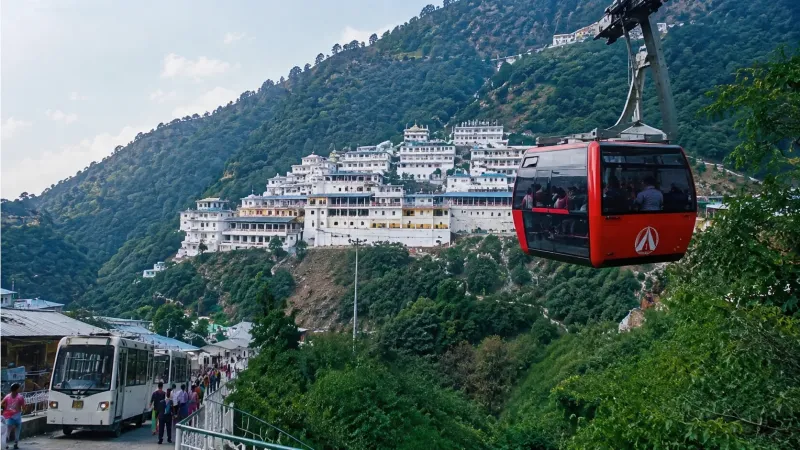
The Shrine Board describes it as an aerial ropeway designed specifically to help pilgrims avoid the arduous climb from Bhawan to Bhairon Ghati.
The Board's current website lists the Bhawan–Bhairon ropeway as operational, with operating hours currently stated as 9 am to 5 pm. Operating arrangements can change for maintenance or other operational reasons, so check the official status close to your journey.
Why the ropeway matters for senior citizens
The Bhairon section is precisely where an otherwise manageable yatra can become unnecessarily exhausting.
For a family travelling with parents, the sensible approach can be:
Walk or use assisted transport to Bhawan → Darshan → take the ropeway to Bhairon Ji → return by ropeway.
The Shrine Board's administrative report describes the ropeway as particularly helpful for elderly and specially-abled pilgrims. It was designed to overcome the steep climb and has a journey time of only a few minutes.
Do not confuse ropeway with helicopter
A simple memory trick:
Helicopter = Katra/Sanjichhat
Ropeway = Bhawan/Bhairon
If a website suggests that the Bhairon ropeway will take you from Katra to Bhawan, it is describing the service incorrectly.
Vaishno Devi Helicopter: The Fastest Way to Cut Down the Trek
For pilgrims who want to minimise the long uphill journey, helicopter is the most significant time- and effort-saving option.
The regular Sector-I helicopter service operates between Katra and Sanjichhat. The Shrine Board's current online system also publishes a separate Sector-II helicopter service involving Jammu and Bhawan/Panchi, with its own booking and refund procedures.
For most families travelling to Katra specifically for the yatra, the service they will be looking at is the Katra–Sanjichhat–Katra sector.
But the helicopter does not take you directly to the cave
This is perhaps the most important thing to understand before booking.
The regular Katra helicopter lands at Sanjichhat, not at the main Bhawan entrance.
From Sanjichhat, pilgrims still have to cover the remaining route to Bhawan. The commonly quoted distance is approximately 2.5 km, although the exact walking experience depends on the route, crowd and conditions.
So helicopter should be thought of as:
Katra → Helicopter → Sanjichhat → remaining journey → Bhawan
rather than:
Katra → Helicopter → Temple
That remaining stretch is especially important for elderly pilgrims.
Who Should Choose the Helicopter?
Helicopter makes the most sense for people for whom the full trek is impractical rather than merely inconvenient.
Consider it particularly when travelling with:
- Elderly parents who cannot manage a long uphill walk
- Pilgrims with significant mobility limitations
- Families with limited time
- Travellers who need to conserve physical energy
- Families combining Vaishno Devi with a wider Jammu or Kashmir itinerary
The Shrine Board currently says a dedicated helicopter ticket quota is available for senior citizens and specially-abled passengers, which is particularly relevant when planning a family yatra.
That does not mean every preferred date will have availability.
Helicopter seats are limited and weather-dependent, so don't build an extremely tight itinerary around the assumption that the flight will operate exactly as scheduled.
How to Book the Helicopter Safely
This is one area where Indian travellers should be particularly careful.
The Shrine Board explicitly warns pilgrims that it has not authorised private travel agents or travel agencies to book its services on its behalf and says Shrine Board services should be booked exclusively through its official website.
That matters because "Vaishno Devi helicopter booking" produces numerous third-party websites in search results.
For the actual Shrine Board service:
- Start from the official Shrine Board website.
- Complete/login to the required pilgrim registration process.
- Select the relevant helicopter sector.
- Check the date and available quota.
- Enter passenger details exactly as required.
- Make payment through the official booking system.
- Save the booking confirmation.
- Carry the required identity documents.
- Check reporting instructions before departure.
The Board's current online portal specifically publishes separate standard operating procedures for cancellation and refunds for the Katra–Sanjichhat sector and the Jammu–Bhawan sector.
Don't treat the helicopter like an ordinary flight ticket
Weather and operational conditions matter.
The Shrine Board's current information also instructs passengers affected by bad weather to process refunds through designated Shrine Board counters at the relevant helipads/airport.
Therefore, if your family is flying out of Jammu or Srinagar shortly after the yatra, leave a sensible buffer.
A helicopter booking should not be followed by a dangerously tight onward flight connection.
What About Children?
Families travelling with small children need to check the applicable age and fare rules for the exact service before booking.
For the current helicopter contracting framework, children below two years are specified as travelling free when carried in an accompanying adult's lap, subject to age verification and the applicable service rules.
Do not assume the same rule applies identically to every other Shrine Board service.
For a family with a toddler, the more useful question is also practical:
Can the child comfortably manage the remaining journey from Sanjichhat to Bhawan?
A helicopter dramatically reduces the trek, but it does not make the pilgrimage completely vehicle-accessible.
Which Option Should Your Family Choose?
Choose the battery car if:
You have parents who are reasonably mobile but cannot comfortably manage the full climb.
It is the middle-ground option:
less walking + lower cost than helicopter + still feels like a pilgrimage journey.
Choose the ropeway if:
Your family can reach Bhawan but wants to avoid the steep climb to Bhairon Ji.
For many senior citizens, this is arguably the most useful add-on to an otherwise conventional yatra.
Choose the helicopter if:
The full trek is physically unrealistic, your family has limited time, or conserving energy is a priority.
Just remember that you still have the Sanjichhat-to-Bhawan section on the regular Katra–Sanjichhat service.
Combine them if:
You are travelling with older parents and want a genuinely comfortable pilgrimage.
A possible combination is:
Helicopter → Sanjichhat → Bhawan → Ropeway → Bhairon Ji
This removes the longest and most demanding part of the traditional climb while retaining the essential pilgrimage experience.
The exact return arrangement should then be planned around the booked helicopter sector, battery-car availability and the family's energy level.
Don't Book Everything Just Because It Is Available
There is another trap in planning Vaishno Devi.
Once families discover that battery cars, helicopters and ropeways exist, they sometimes try to use every service.
That isn't necessarily better.
For a fit 30-year-old, walking a substantial portion of the route may be part of the experience.
For a 70-year-old parent with limited stamina, forcing the same route simply because "we all should do it together" can turn the pilgrimage into an ordeal.
The right question is:
What transport allows this particular family to complete the yatra comfortably and safely?
Not:
What is the cheapest option?
And not:
What is the fastest option?
A Practical Decision Guide
If you're travelling with:
Young, fit adults:Walk as much of the route as you comfortably can; consider the ropeway for Bhairon Ji.
Parents who can walk but tire easily:Consider the battery car for the Adhkuwari–Bhawan section and the ropeway for Bhairon Ji.
Senior citizens with significant mobility limitations:Consider helicopter for Katra–Sanjichhat, then plan the remaining section carefully.
A mixed family group:Don't force everyone into one transport mode. The more mobile members can walk while older family members use the available assisted options, provided everyone is reunited safely at the planned points.
A very tight itinerary:Helicopter can save substantial travel time, but keep a buffer for weather and operational disruption.
The Most Important Booking Rule: Use the Shrine Board
For a pilgrimage this popular, third-party "guaranteed" tickets can be tempting.
Don't take the risk.
The Shri Mata Vaishno Devi Shrine Board itself says its services—including helicopter bookings—should be booked through its official website and warns against unauthorised agencies.
Official Shri Mata Vaishno Devi Shrine Board booking portal
Before travelling, also check the official portal for:
- Current service availability
- Current fares
- Booking quotas
- Cancellation/refund rules
- Weather-related updates
- Ropeway operating status
- Current reporting instructions
These details can change, and an old travel blog may still be showing fares or rules from a previous season.
The Best Vaishno Devi Transport Plan Is the One That Matches the Pilgrim
There is no universally "best" way to reach Vaishno Devi.
The battery car is the practical middle ground.
The Bhawan–Bhairon ropeway is an excellent way to avoid the steep final climb to Bhairon Ji.
The helicopter is the biggest reduction in physical effort, but even helicopter passengers should remember that the regular Katra service lands at Sanjichhat rather than at the shrine itself.
For Indian families travelling with parents or children, that distinction is crucial.
Plan the yatra around the person who will find the journey hardest—not the person who can walk the fastest.
That is the difference between merely reaching Bhawan and actually having a peaceful pilgrimage.
For a Bookmywings itinerary, the transport choice should therefore be treated as part of the family's yatra design, not simply as an optional add-on: understand the group's age, mobility, available time and comfort level first, then choose the combination of walking, battery car, ropeway and helicopter that makes sense.